
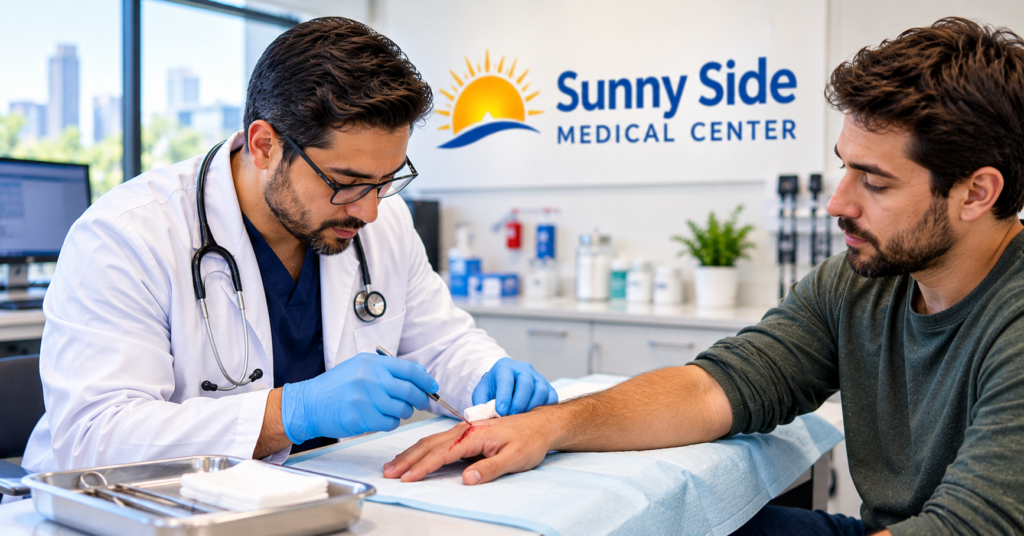
A deep cut can happen in an instant. A kitchen knife slips, a piece of glass breaks or a fall leaves a wound that will not stop bleeding. Your first thought is usually whether the cut needs stitches and where to go.
The good news is that most cuts and lacerations that require stitches can be treated at urgent care rather than the emergency room. Urgent care clinics are equipped to evaluate wounds, clean them properly and close them with sutures, adhesive strips or medical glue, depending on the type and location of the cut.
This guide explains how to tell if a cut needs stitches, what to expect during treatment and why urgent care is often the best option for wound closure in Chicago.
Ready to Take the Next Step for Your Health?
Whether you need a routine check-up, urgent care visit, or just want to talk to a doctor about your symptoms — Sunny Side Medical Center is here for you.
We offer walk-in and same-day appointments for patients of all ages in Chicago.
Book an Appointment Today →
Can Urgent Care Do Stitches?
Yes. Urgent care clinics like Sunny Side Medical Center are equipped and staffed to handle most lacerations that require stitches. Urgent care providers routinely perform wound evaluation, cleaning, numbing and suturing as part of their everyday practice.
What Types of Wounds Can Urgent Care Treat?
Urgent care can treat a wide range of cuts and lacerations, including:
- Kitchen knife cuts on hands and fingers
- Cuts from broken glass
- Lacerations from falls or scrapes against sharp edges
- Minor puncture wounds
- Cuts on the arms, legs, hands, feet and scalp
- Wounds from minor accidents at home or work
- Animal scratches that break the skin (bite wounds may require additional evaluation)
When Should You Go to the ER Instead?
While urgent care handles most wounds that need stitches, some injuries are better treated in an emergency room:
- Deep wounds with visible muscle, tendon or bone
- Wounds with uncontrolled bleeding that does not slow with direct pressure after 10 to 15 minutes
- Facial lacerations near the eyes, lips or involving significant tissue damage
- Wounds with embedded objects (glass, metal or other debris lodged deep in the tissue)
- Animal bites that are deep, on the face or show signs of infection
- Wounds with loss of sensation or movement below the injury
- Major trauma involving other injuries such as head injuries or broken bones
If you are unsure, call Sunny Side Medical Center at 773-292-9660 to describe your wound. The team can help you determine whether urgent care is the right setting for your injury.
How to Tell if a Cut Needs Stitches
Not every cut requires medical treatment. Here are the signs that a wound likely needs professional closure:
Signs Your Cut Needs Stitches
- The cut is deeper than a quarter inch. If the wound goes deeper than the surface layer of skin, it likely needs closure.
- The edges of the wound do not come together on their own. If the sides of the cut gap open when you release pressure, stitches may be needed to hold them together for proper healing.
- The cut is longer than half an inch. Longer cuts generally benefit from professional closure even if they are not particularly deep.
- Bleeding does not stop after 10 to 15 minutes of direct pressure. Continued bleeding suggests a wound that needs medical attention.
- The cut is on a joint or area that moves a lot. Wounds on knuckles, elbows, knees and other areas that flex and bend frequently are more likely to reopen without stitches.
- Fat or muscle tissue is visible. Yellowish fatty tissue or red muscle tissue visible in the wound indicates it needs medical closure.
- The wound was caused by a dirty or rusty object. These wounds may need professional cleaning, closure and a tetanus booster.
- The cut is on the face. Facial wounds often benefit from professional closure to minimize scarring.
When a Cut May Not Need Stitches
Minor cuts that are shallow, have edges that naturally come together and stop bleeding with gentle pressure may not require stitches. These wounds can often be managed at home with:
- Gentle cleaning with clean water
- Application of antibiotic ointment
- A clean bandage or adhesive bandage
- Monitoring for signs of infection
What to Do Before Getting Stitches
If you think your cut needs stitches, take these steps while you prepare to visit urgent care:
Step 1: Apply Direct Pressure
Use a clean cloth, gauze or towel and press firmly against the wound. Maintain steady pressure for at least 10 minutes without lifting to check. Elevation of the injured area above heart level can also help slow bleeding.
Step 2: Keep the Wound Clean
If possible, gently rinse the wound with clean running water to remove visible dirt or debris. Do not scrub the wound or use hydrogen peroxide, iodine or alcohol directly on an open wound, as these can damage tissue.
Step 3: Cover the Wound
After applying pressure and slowing the bleeding, cover the wound with a clean bandage or cloth for the trip to the clinic.
Step 4: Get to Urgent Care Promptly
For the best results, stitches should ideally be placed within 6 to 8 hours of the injury. Wounds left open too long have a higher risk of infection and may not be candidates for suturing.
The Stitches Procedure at Urgent Care
Knowing what to expect can ease any anxiety about getting stitches. Here is what happens during a typical visit at Sunny Side Medical Center.
Wound Evaluation
Your provider will examine the wound to assess its depth, length and location. They will check for signs of nerve or tendon involvement and determine whether imaging is needed to look for foreign bodies like glass fragments.
Wound Cleaning
Proper wound cleaning is one of the most important steps in preventing infection. Your provider will irrigate the wound with a sterile solution to flush out bacteria, dirt and debris. This step is thorough and critical for a good outcome.
Numbing the Area
Before placing stitches, the provider will numb the area around the wound with a local anesthetic. You may feel a brief sting during the injection, but once the area is numb, you should not feel pain during the suturing process.
Closing the Wound
The provider will carefully align the edges of the wound and place stitches to hold them together. The number of stitches depends on the size and location of the cut. The provider uses techniques designed to minimize scarring and promote even healing.
Wound Dressing
After the stitches are placed, the provider will apply an appropriate dressing to protect the wound. You will receive instructions on how to care for the wound at home.
Types of Wound Closure
Stitches are not the only method for closing wounds. Your provider will choose the best method based on the wound type, location and depth.
Sutures (Traditional Stitches)
Thread-like material is used to sew the wound edges together. Sutures can be absorbable (dissolve on their own) or non-absorbable (require removal at a follow-up visit).
Adhesive Strips (Butterfly Bandages)
Thin adhesive strips are placed across a wound to hold the edges together. These work well for small, shallow cuts in areas with low tension.
Medical Skin Glue
A liquid adhesive is applied over the wound to bond the skin edges together. Skin glue works well for small, clean cuts with smooth edges. It does not require removal because it naturally peels off as the wound heals.
Staples
Metal staples are sometimes used for wounds on the scalp or other areas where speed of closure is important. Staples require removal at a follow-up visit.
Caring for Your Stitches After Treatment
Proper wound care after getting stitches is essential for healing and minimizing the risk of infection and scarring.
Keep the Wound Clean and Dry
- Keep the bandage on and the wound dry for the first 24 hours
- After 24 hours, gently clean the wound daily with mild soap and water
- Pat dry with a clean towel
- Apply antibiotic ointment if recommended by your provider
- Cover with a clean bandage
Watch for Signs of Infection
Contact your healthcare provider or return to urgent care if you notice:
- Increasing redness, swelling or warmth around the wound
- Red streaks extending from the wound
- Pus or foul-smelling drainage
- Fever
- Increasing pain rather than decreasing pain
Protect the Wound
- Do not pick at or pull on the stitches
- Avoid activities that put tension on the wound
- Protect the area from direct sun exposure to reduce scarring
- Avoid submerging the wound in water (baths, pools, hot tubs) until stitches are removed
Stitch Removal
Non-absorbable stitches need to be removed by a healthcare provider. Removal timing depends on the wound location:
- Face: 3 to 5 days
- Scalp: 7 to 10 days
- Arms and legs: 7 to 10 days
- Joints: 10 to 14 days
- Trunk: 7 to 10 days
Your provider will tell you when to return for stitch removal. Sunny Side Medical Center offers follow-up visits for stitch removal and wound checks through primary care services.
Cost of Stitches at Urgent Care
Getting stitches at urgent care is generally less expensive than an emergency room visit. While costs vary depending on the complexity of the wound and your insurance coverage, urgent care provides significant savings compared to ER pricing for the same procedure.
Sunny Side Medical Center accepts both in-network and out-of-network insurance. Self-pay patients without insurance are also welcome. Call 773-292-9660 to discuss payment options before your visit.
Why Choose Urgent Care Over the ER for Stitches
For wounds that do not involve major trauma or life-threatening bleeding, urgent care offers several advantages:
- Shorter wait times. Emergency rooms prioritize patients by severity. A cut that needs stitches may mean a long wait behind more critical cases.
- Lower cost. Urgent care visits are typically a fraction of the cost of an ER visit for similar wound care.
- Convenient access. Walk-in availability means you can get treated promptly without an appointment.
- Continuity of care. At Sunny Side Medical Center, you can return to the same clinic for stitch removal and wound follow-up.
Chicago Neighborhoods We Serve
Sunny Side Medical Center at 3228 W. North Ave. provides walk-in wound care and stitches for patients from:
- Logan Square — Minutes from the clinic along North Avenue
- Hermosa — Home to Sunny Side Medical Center
- Humboldt Park — South of the clinic along North Avenue
- Avondale — North of Logan Square
- West Town — East of the clinic
- Bucktown — Bordering Logan Square
- Wicker Park — South of Bucktown
- Belmont Cragin — West of Hermosa
Frequently Asked Questions About Stitches at Urgent Care
Can urgent care give stitches?
Yes. Urgent care clinics are equipped to evaluate, clean and suture most cuts and lacerations. Providers at Sunny Side Medical Center routinely treat wounds that require stitches.
How do I know if my cut needs stitches?
A cut likely needs stitches if it is deeper than a quarter inch, longer than half an inch, has edges that gap open, continues bleeding after 10 to 15 minutes of direct pressure, exposes fat or muscle tissue or is located on a joint or the face.
How much do stitches cost at urgent care?
Costs vary based on the wound complexity and your insurance coverage. Urgent care stitches are generally much less expensive than the same treatment at an emergency room. Call 773-292-9660 to discuss costs and payment options.
How long do I have to get stitches after a cut?
For the best results, stitches should be placed within 6 to 8 hours of the injury. After this window, the risk of infection increases and the wound may not be suitable for suturing.
Do stitches at urgent care hurt?
The area around the wound is numbed with a local anesthetic before stitches are placed. You may feel a brief sting during the numbing injection, but the suturing itself should not be painful.
When do stitches need to be removed?
Removal timing depends on location. Facial stitches are typically removed in 3 to 5 days. Stitches on the arms, legs or scalp are usually removed in 7 to 10 days. Joint stitches may stay in for 10 to 14 days.
Can I shower with stitches?
Keep the wound dry for the first 24 hours. After that, you can gently clean the area with mild soap and water during a shower. Avoid soaking the wound in a bath, pool or hot tub until stitches are removed.
What if my wound gets infected after stitches?
Contact your provider if you notice increasing redness, swelling, warmth, pus, fever or worsening pain around the wound. Early treatment of wound infections can prevent more serious complications.
Get Same-Day Stitches in Chicago
Do not wait to get a cut evaluated. The sooner a wound is properly cleaned and closed, the better the outcome. Walk in to Sunny Side Medical Center for prompt wound evaluation and treatment.
Need stitches for a cut or laceration in Chicago?
📞 Call Sunny Side Medical Center at 773-292-9660 or book an appointment online.
📍 Sunny Side Medical Center
3228 W. North Ave., Chicago, IL 60647
📧 info@sunnysidemedicalcenter.com
Walk-ins welcome. Monday through Friday 9 AM to 5 PM. Saturday 9 AM to 1 PM.
Follow Sunny Side Medical Center:
Facebook | Instagram | LinkedIn
Ready to Take the Next Step for Your Health?
Whether you need a routine check-up, urgent care visit, or just want to talk to a doctor about your symptoms — Sunny Side Medical Center is here for you.
We offer walk-in and same-day appointments for patients of all ages in Chicago.
Book an Appointment Today →

