
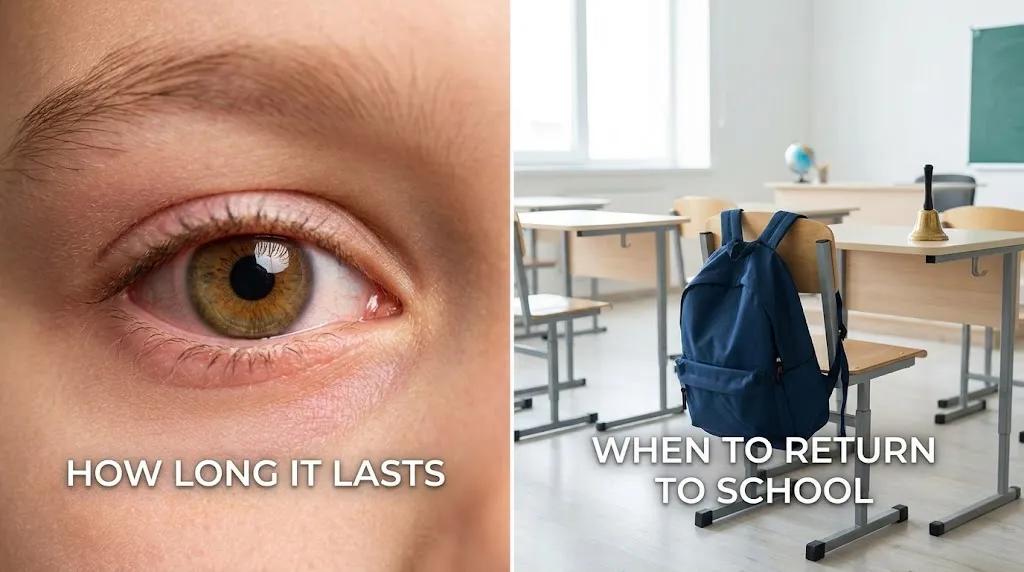
Quick answer: Wondering how long does pink eye last? It depends on the cause. Viral pink eye usually lasts one to two weeks (sometimes up to three) and gets better without antibiotics. Bacterial pink eye often improves within two to five days and clears within about a week or so, faster with antibiotic drops or ointment. Allergic pink eye lasts as long as you are exposed to the trigger and is not contagious. Most children do not need to stay home for pink eye alone, according to the CDC and the American Academy of Pediatrics, unless they have a fever, feel unwell or cannot avoid close contact with others. However, many schools and daycares have their own rules, so check your child’s policy.
Pink eye spreads quickly through classrooms, daycares and households, and it often shows up at the worst possible time. This guide explains how long each type usually lasts, how long it is contagious, what helps at home and how to handle school and work.

How Long Does Pink Eye Last? By Type
| Type | Typical duration | Contagious? | Antibiotics help? |
|---|---|---|---|
| Viral conjunctivitis | 1–2 weeks, sometimes up to 3 | Yes, while symptoms are present | No |
| Bacterial conjunctivitis | 2–5 days to improve; about 7–10 days to clear | Yes; much less after ~24 hours on antibiotics | Often yes |
| Allergic conjunctivitis | As long as exposure continues | No | No |
| Irritant conjunctivitis | Often hours to a day after removing the irritant | No | No |
Not sure which type you have? See viral vs. bacterial pink eye and pink eye vs. allergies.
How Long Is Pink Eye Contagious?
Viral pink eye
Viral conjunctivitis can be contagious before symptoms start and for as long as the eye is red and tearing, which can be up to two weeks. Some adenovirus infections remain contagious for longer.
Bacterial pink eye
Bacterial conjunctivitis is contagious while there is discharge. After starting appropriate antibiotic drops or ointment, people usually become much less contagious within about 24 hours.
Allergic pink eye
Allergic conjunctivitis is not contagious at all.
How Do You Get Pink Eye?
Infectious pink eye spreads through:
- Hand-to-eye contact after touching contaminated surfaces, tissues or hands
- Close personal contact, such as hugging or shaking hands
- Sharing items like towels, pillowcases, washcloths, makeup or eye drops
- Respiratory droplets from coughs and sneezes (for viral types)
- Contact lenses that are not cleaned properly
Children are especially likely to spread pink eye because they touch their eyes often and share close space at school.
Does Pink Eye Go Away on Its Own?
Often, yes:
- Viral pink eye almost always goes away on its own within one to three weeks.
- Mild bacterial pink eye can also clear without treatment, though antibiotics may shorten it.
- Allergic pink eye improves once triggers are avoided or treated.
However, some types need prompt treatment, including infections caused by herpes viruses, gonorrhea or chlamydia, and any pink eye in a newborn.

Pink Eye Treatment: What Helps
Comfort care for all types
- Compresses: Cool compresses can ease itching and swelling; warm compresses can loosen crusts. Use a clean cloth for each eye and each time.
- Artificial tears: Preservative-free lubricating drops can soothe irritation.
- Gentle cleaning: Wipe discharge from the inner corner outward with a clean, damp cloth.
- Skip contact lenses until the eye is completely clear. Replace lenses and the case.
- Avoid eye makeup until healed, and throw away products used during infection.
Bacterial pink eye
Your provider may prescribe antibiotic eye drops or ointment. Use them as directed and finish the full course.
Viral pink eye
Comfort care is the main treatment. Antibiotics do not help. Certain viral infections, such as herpes, need antiviral medicine.
Allergic pink eye
Antihistamine or anti-allergy eye drops, avoiding triggers and treating nasal allergies can help.
Treating pink eye at home: what to avoid
- Do not use leftover antibiotic drops or someone else’s medicine.
- Do not use “redness relief” drops long term.
- Do not put breast milk, tea bags, honey or other home remedies in the eye. These can introduce bacteria.
- Do not rub your eyes.
Can Kids Go to School With Pink Eye?
This is one of the most common questions parents ask.
What national guidance says: The CDC and the American Academy of Pediatrics generally advise that children with pink eye do not need to be kept home unless:
- They have a fever or feel too unwell to participate
- They cannot avoid close contact with other children
- Their school or daycare requires them to stay home or start treatment first
- They are part of an outbreak where health officials have recommended exclusion
What schools often require: Many schools and daycares have stricter policies, such as requiring children with bacterial pink eye to have been on antibiotics for 24 hours, or requiring a note from a healthcare provider. Policies vary, so check with your child’s school, daycare or Chicago Public Schools campus.
Practical return-to-school checklist
- No fever for at least 24 hours without medicine
- Feeling well enough to participate
- Discharge is minimal or controlled
- On antibiotics for at least 24 hours, if bacterial and if required by school
- Your child understands not to rub their eyes and to wash hands often
- Any required provider note is ready
If your child needs a provider note for school, we can evaluate them and provide documentation. While you are here, you can also check whether they are due for a school physical.
Can Adults Go to Work With Pink Eye?
Most adults can return to work when they feel well enough, as long as they:
- Wash hands frequently
- Avoid touching their eyes
- Do not share items
- Avoid close contact, especially in healthcare, childcare or food service jobs
Some workplaces, particularly healthcare and childcare settings, have specific policies. Check with your employer.
Preventing Pink Eye From Spreading at Home
- Wash hands frequently with soap and water, especially after touching the eyes
- Give each person their own towel, washcloth and pillowcase, and wash them in hot water
- Clean shared surfaces like doorknobs, faucets, light switches, remotes and phones
- Do not share eye drops, makeup or contact lens supplies
- Throw away tissues right after use
- Keep children’s hands clean and remind them not to rub their eyes
When to See a Provider
Visit urgent care or your primary care provider if:
- There is thick yellow or green discharge
- Symptoms are not improving after a few days or are getting worse
- Pink eye lasts longer than two weeks
- A school or daycare requires an evaluation or note
- The person has a weakened immune system
- The person wears contact lenses
Seek urgent or emergency care for:
- Moderate to severe eye pain
- Light sensitivity
- Blurred vision that does not improve with blinking
- Blisters on or around the eyelids
- A newborn with red eyes or discharge
- Intense redness with headache or nausea
Pink Eye in Babies and Toddlers
Pink eye in newborns (the first month of life) can be caused by infections passed during birth and needs immediate medical evaluation. Babies can also have blocked tear ducts, which cause tearing and discharge and may look like pink eye.
For toddlers, ointment may be easier to apply than drops. Ask your provider for tips.
How to Know Pink Eye Is Going Away
Signs of improvement include:
- Less redness each day
- Less discharge and crusting in the morning
- Less irritation or grittiness
- Eyes opening easily after sleep
If the eye is getting worse instead of better after several days, or if new symptoms appear, get checked.
Get Pink Eye Evaluated at Sunny Side Medical Center
Whether your child needs a note to go back to school or you just want to know what you are dealing with, the team at Sunny Side Medical Center can help.
- Eye exams for children, adults and seniors
- Prescriptions when appropriate, plus on-site pharmacy and delivery
- School and work notes when needed
- Same-day and walk-in care for appropriate conditions
- In-network and out-of-network insurance, plus self-pay options
Located at 3228 W. North Ave., Chicago, serving Logan Square, Hermosa, Humboldt Park, Avondale and West Town.
Book an appointment or call 773-292-9660. Follow us on Facebook, Instagram, and LinkedIn for more health updates and news.
Frequently Asked Questions
How long does pink eye last?
Viral pink eye typically lasts one to two weeks. Bacterial pink eye often improves in two to five days and clears faster with antibiotics. Allergic pink eye lasts as long as exposure to the trigger.
How long is pink eye contagious?
Viral pink eye can be contagious as long as symptoms last. Bacterial pink eye becomes much less contagious about 24 hours after starting antibiotics. Allergic pink eye is not contagious.
Can my child go to school with pink eye?
National guidance says most children do not need to stay home for pink eye alone unless they have a fever or feel unwell, but many schools have their own rules. Check your school’s policy.
Does pink eye go away on its own?
Viral and mild bacterial pink eye often do. Some types need treatment, so see a provider if symptoms are severe or not improving.
How do you get pink eye?
Usually by touching your eyes after touching contaminated hands or surfaces, or by sharing towels, makeup or pillowcases.
How can I treat pink eye at home?
Use clean compresses, artificial tears and gentle cleaning. Avoid contact lenses and makeup. See a provider for thick discharge, pain or vision changes.
Is a warm or cold compress better for pink eye?
Cool compresses help itching and swelling; warm compresses help loosen crusts. Use a clean cloth for each eye.

