
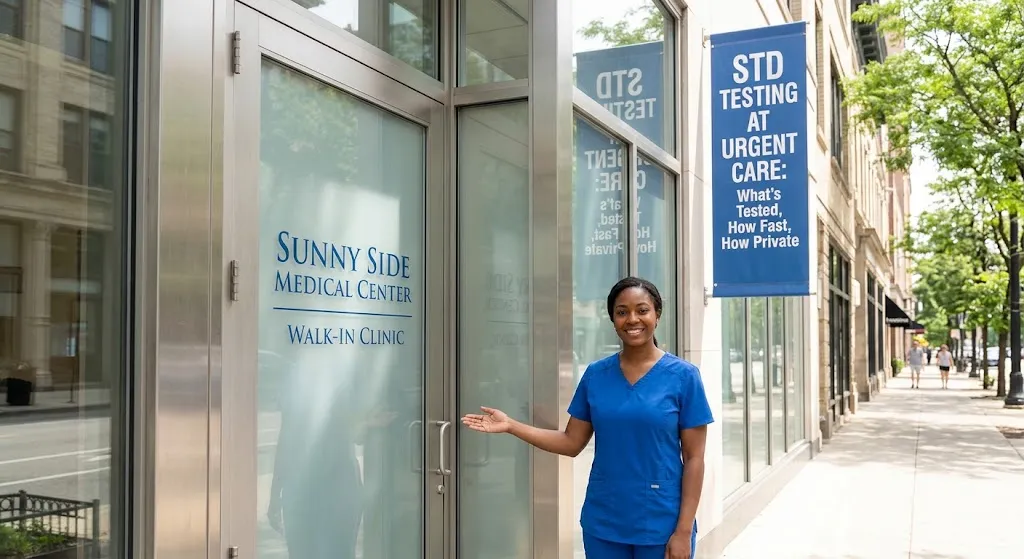
Quick answer: Urgent care std testing provides a fast way to check for sexually transmitted infections (STIs, also called STDs). A typical visit includes a brief, confidential conversation about symptoms and exposures, then a urine sample, a swab and/or a blood draw, depending on which infections are being checked. Common tests include chlamydia, gonorrhea, trichomoniasis, syphilis, HIV and hepatitis B and C. Some rapid tests give results the same day, while many lab tests take one to several days. Your results are protected health information under federal privacy law. Because test windows matter, tell the provider when your possible exposure happened.
Getting tested for STIs can feel stressful, but it is a routine, responsible part of health care. Many STIs cause no symptoms at all, so testing is the only way to know your status. This guide explains what to expect at an urgent care or walk-in clinic, which tests are common, how long results take, what it may cost and how your privacy is protected.
Does Urgent Care Do STD Testing?
Many urgent care and walk-in clinics do, but services vary by location. Some test for a full panel on-site or through a partner lab; others focus on symptom-based testing and treatment. Before you go, call to ask:
- Which STIs they test for
- Whether testing is done on-site or sent to a lab
- How long results take
- How results will be shared with you
- The self-pay price if you are not using insurance
Why STI Testing Matters
- Many STIs have no symptoms. Chlamydia and gonorrhea often cause no noticeable signs, especially in women.
- Untreated infections can cause complications, such as pelvic inflammatory disease, infertility, chronic pain and increased risk of HIV.
- Most bacterial STIs are curable with the right antibiotics.
- Viral STIs such as HIV, herpes and hepatitis B can be managed effectively with treatment.
- Testing protects partners by helping prevent ongoing spread.
Who Should Get Tested?
CDC screening recommendations include:
| Group | Recommended screening |
|---|---|
| Everyone ages 13–64 | HIV test at least once |
| Sexually active women under 25 | Chlamydia and gonorrhea every year |
| Women 25+ with risk factors (new or multiple partners, partner with an STI) | Chlamydia and gonorrhea every year |
| Pregnant people | Syphilis, HIV, hepatitis B and C early in pregnancy; others based on risk |
| Sexually active gay, bisexual and other men who have sex with men | Syphilis, chlamydia and gonorrhea at least yearly; HIV at least yearly (more often if higher risk) |
| Anyone with symptoms or a partner with an STI | Testing based on exposure |
| Adults 18+ | Hepatitis C at least once |
Your provider may recommend testing more or less often based on your situation.
What’s Included in an STD Panel?
There is no single standard “full panel.” Tests are chosen based on your symptoms, exposure and history. Common STI tests include:
| Infection | Typical sample | Notes |
|---|---|---|
| Chlamydia | Urine or swab | Throat or rectal swabs may be recommended based on exposure |
| Gonorrhea | Urine or swab | Usually tested together with chlamydia |
| Trichomoniasis | Urine or swab | Common, often no symptoms |
| Syphilis | Blood | Rates have risen significantly in recent years |
| HIV | Blood or rapid test | Fourth-generation tests detect infection earlier |
| Hepatitis B | Blood | Vaccine-preventable |
| Hepatitis C | Blood | Curable with treatment |
| Herpes (HSV) | Swab of a sore | Blood tests are not routinely recommended without symptoms |
| HPV | Part of cervical cancer screening | No routine HPV test for men |
Why “full panel” can be misleading: Testing urine only may miss infections in the throat or rectum. Tell the provider about all types of sexual contact so the right sites are tested.

How Is STD Testing Done?
- Private conversation. The provider asks about symptoms, when a possible exposure occurred, types of sexual contact and any previous STIs. This is confidential and judgment-free.
- Exam, if needed. If you have symptoms such as discharge, sores or pain, the provider may examine the area.
- Sample collection:
- Urine sample for chlamydia, gonorrhea and trichomoniasis
- Swabs of the throat, rectum, vagina or a sore, sometimes self-collected
- Blood draw for HIV, syphilis and hepatitis
- Treatment, if appropriate. If you have symptoms or a known exposure, the provider may recommend treatment before results come back.
Sunny Side Medical Center has on-site clinical laboratory services to support testing. Call to confirm which STI tests are available for your visit.
How Fast Are STD Test Results?
| Test type | Typical turnaround |
|---|---|
| Rapid HIV test | About 20–30 minutes |
| Rapid syphilis test (where available) | Minutes |
| Urine/swab lab tests (chlamydia, gonorrhea, trich) | Often 1–3 days, varies by lab |
| Blood tests (HIV, syphilis, hepatitis) | Often 1–5 days, varies by lab |
A positive rapid test usually needs a confirmatory lab test.
When Should You Get Tested After Exposure?
Testing too soon may produce a false negative. Approximate window periods:
| Infection | When testing becomes reliable (approximate) |
|---|---|
| Chlamydia / gonorrhea | About 1–2 weeks after exposure |
| Trichomoniasis | About 1 week to 1 month |
| Syphilis | About 3–6 weeks; retest may be advised |
| HIV (4th-generation lab test) | About 18–45 days |
| Hepatitis B | About 3–6 weeks |
| Hepatitis C | About 8–11 weeks for antibody tests |
If you were exposed recently, your provider may suggest testing now and retesting later.
Possible HIV exposure in the last 72 hours? Ask about post-exposure prophylaxis (PEP) right away. PEP must be started within 72 hours to be effective. Emergency departments can provide PEP if a clinic cannot.
STD Symptoms That Mean Get Checked Soon
- Unusual discharge from the penis or vagina
- Burning or pain with urination
- Sores, bumps or blisters on the genitals, mouth or anus
- Pelvic or lower abdominal pain
- Pain during sex
- Bleeding between periods or after sex
- Testicular pain or swelling
- A rash on the palms or soles
- Flu-like symptoms after a possible HIV exposure
Some symptoms, such as burning with urination, can also be caused by a urinary tract infection. Learn more in how long a UTI lasts. Testing can tell the difference.

How Private Is STD Testing?
Privacy is a top concern for many people. Key protections include:
- HIPAA (the federal Health Insurance Portability and Accountability Act) protects your health information. Clinics cannot share your results with your employer, family or others without your permission, except in limited situations required by law.
- Public health reporting: Certain infections, such as chlamydia, gonorrhea, syphilis and HIV, must be reported to public health departments. These reports are confidential and used to track disease and offer partner services.
- Insurance statements: If you use insurance, an explanation of benefits (EOB) may be sent to the policyholder. If this is a concern, ask about self-pay options or your plan’s confidential communication rights.
- Minors in Illinois: Illinois law generally allows minors 12 and older to consent to their own STI testing and treatment. Ask the clinic about its policies.
What Does STD Testing Cost?
Cost depends on which tests are run and whether you use insurance.
- With insurance: Many plans cover recommended STI screenings as preventive care. Diagnostic testing for symptoms may involve copays or deductibles.
- Without insurance: Self-pay prices vary by clinic and by test. Ask for an itemized estimate.
- Low-cost options: The Chicago Department of Public Health and community health centers may offer free or low-cost STI testing.
Sunny Side Medical Center welcomes self-pay patients. See going to urgent care without insurance for more on costs.
What Happens If You Test Positive?
- Bacterial STIs (chlamydia, gonorrhea, syphilis, trichomoniasis) are usually curable with antibiotics.
- Viral STIs (HIV, herpes, hepatitis B) are treatable and manageable with medication.
- Hepatitis C is curable with antiviral treatment.
- Partner notification: Your provider will explain how to let partners know so they can be tested and treated. Some health departments can notify partners anonymously.
- Avoid sex until you and your partners finish treatment and any recommended waiting period.
- Retesting is often recommended about three months after treatment for chlamydia and gonorrhea.
Testing positive is a health issue, not a moral one. Getting tested and treated is the responsible thing to do.
How to Lower Your STI Risk
- Use condoms consistently and correctly
- Get vaccinated against HPV and hepatitis B
- Ask about PrEP if you are at higher risk for HIV
- Get tested regularly and talk with partners about testing
- Limit the number of partners or choose mutual monogamy with a tested partner
STD Testing in Chicago at Sunny Side Medical Center
[Clinic to confirm before publishing: STI testing services, on-site vs. send-out tests, result times and pricing.]
Sunny Side Medical Center offers confidential, respectful care at 3228 W. North Ave., Chicago, near Logan Square, Hermosa, Humboldt Park, Avondale and West Town.
- Private consultations with a provider
- On-site clinical laboratory support
- Treatment and prescriptions when appropriate
- Urgent care for symptoms such as burning with urination or discharge
- In-network and out-of-network insurance, plus self-pay options
Hours: Monday–Friday 9:00 AM–5:00 PM · Saturday 9:00 AM–1:00 PM
Book an appointment or call 773-292-9660. Questions about privacy or pricing? Contact us. Follow us on Facebook, Instagram, and LinkedIn for more health updates and news.
Frequently Asked Questions About Urgent Care STD Testing
Does urgent care do STD testing?
Many urgent care and walk-in clinics do. Services vary, so call ahead to confirm which tests are offered.
What does a full STD panel include?
Commonly chlamydia, gonorrhea, trichomoniasis, syphilis, HIV and hepatitis B and C. The right tests depend on your exposure and symptoms.
How long do STD test results take?
Rapid tests can take minutes. Lab tests often take one to several days.
Is STD testing confidential?
Yes. Results are protected under HIPAA. Some infections must be reported to public health, which is also confidential.
How soon after exposure should I get tested?
It depends on the infection; many tests become reliable one to six weeks after exposure. Your provider may suggest testing now and again later.
Can I get STD testing without insurance?
Yes. Ask about self-pay pricing, and check public health clinics for low-cost options.
Do I need an appointment for STD testing?
Walk-in care may be available at many clinics. Calling ahead helps confirm test availability.

