

If you drive for a living or you are about to start a job that puts you behind the wheel of a commercial motor vehicle, someone has probably already told you that you need a DOT physical. A DOT physical is a medical exam required by the Federal Motor Carrier Safety Administration or FMCSA, to check whether a driver is healthy enough to safely operate a commercial vehicle.
It is not the same as your regular yearly physical and it does not get done by just any doctor. This piece walks through what the exam covers, who needs one, what the paperwork looks like and how to get ready for it, written in plain everyday language for people in Chicago who just want a straight answer.
What Is a DOT Physical Exam?
A DOT physical exam is a health check that commercial drivers are required to pass under federal law before they can legally operate a commercial motor vehicle. The exam looks at vision, hearing, blood pressure, heart and lung health and general medical history to confirm the driver does not have a condition that would make driving a commercial vehicle unsafe.
Here is the thing about it though. It is not really about catching every little health issue. It is about one specific question. Can this person safely handle a commercial motor vehicle for hours at a time without a medical event putting themselves or someone else on the road at risk. That is the whole point of the DOT medical exam and it shapes everything that happens during the visit.
The exam has to be done by someone trained and certified specifically for this purpose, which we will get into below. And it results in one of two outcomes. You either get certified to drive or you do not, at least not yet.
What Is a DOT Medical Card?
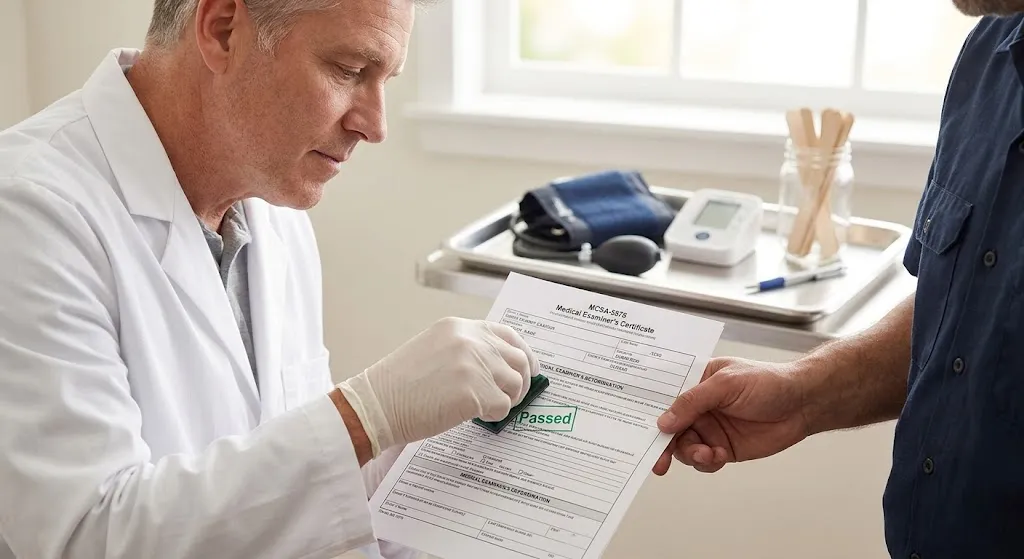
A DOT medical card is the common name for the Medical Examiner’s Certificate, the paper you get after passing your DOT physical that proves you are qualified to drive a commercial motor vehicle. Drivers usually carry a copy of it and it also gets linked to their driving record.
Once the medical examiner finds a driver meets the physical qualification standards, they fill out a Medical Examiner’s Certificate, form MCSA 5876. That certificate is what people mean when they say dot medical card. It is small, it is easy to lose and a lot of drivers keep a photo of it on their phone just in case, though the original still needs to go with their license paperwork in most states.
The medical card is not permanent. It comes with an expiration date and driving past that date without a new one is a problem for both the driver and whoever they are hauling for.
Who Actually Needs a DOT Physical
Generally, anyone who drives a commercial motor vehicle in interstate commerce or who needs a commercial driver’s license for certain vehicle classes, needs a current medical certificate on file. That includes truck drivers, bus drivers and other operators who fall under FMCSA rules.
There is some nuance here depending on vehicle weight, what is being hauled and whether the driving crosses state lines, so if you are not sure whether your specific job requires one, the FMCSA site and your employer’s safety department are the two places to get a firm answer rather than guessing. A lot of drivers assume it only applies to long haul trucking. It does not. Plenty of local delivery and transit jobs fall under the same requirement.
What Does a DOT Physical Consist Of
A DOT physical consists of a health history review, a vision test, a hearing test, a blood pressure and pulse check, a urinalysis and a general physical exam covering the heart, lungs, abdomen, spine and nervous system. Each part exists to catch something specific that could affect driving safety.
Walking through it in a bit more detail helps take the mystery out of it.
Health history. You will fill out a form covering past and current medical conditions, surgeries, medications and anything that could affect your ability to drive. Be honest here. Leaving something off does not make the condition go away and it can cause bigger problems later if it comes up during a review.
Vision. The examiner checks that you can see well enough, with or without corrective lenses and that your peripheral vision is wide enough to safely watch the road on both sides.
Hearing. Drivers need to be able to hear a forced whisper from about five feet away in at least one ear, either without a hearing aid or with one if that is what gets them there. This part trips people up more than they expect, especially if they have not had a hearing check in years.
Blood pressure and pulse. This is one of the most common reasons a driver gets a shorter certification period instead of a straight two year card. High blood pressure does not automatically disqualify someone but depending on the reading, the examiner may certify for a shorter stretch and ask for a recheck.
Urinalysis. This part of the exam checks for things like protein, blood or sugar in the urine, which can point to kidney issues or diabetes. It is a medical screening, not a drug test, which is a mix up we will clear up in a second.
General physical. Heart, lungs, abdomen, spine, joints and neurological function all get a basic once over.
A simple table makes this easier to scan:
| Exam Component | What It Checks For |
|---|---|
| Health history | Past and current medical conditions, surgeries, medications |
| Vision | Visual acuity with or without corrective lenses, peripheral vision |
| Hearing | Ability to hear a forced whisper or meet audiometric standard, with or without a hearing aid |
| Blood pressure and pulse | Cardiovascular stability, certification length |
| Urinalysis | Protein, blood or sugar as markers for kidney issues or diabetes |
| General physical | Heart, lungs, abdomen, spine, joints and nervous system |
Does a DOT Physical Include a Drug Test?
No, the DOT physical exam itself does not include a drug test. The urinalysis done during the exam checks for medical markers like protein, blood and sugar, not for drugs or alcohol.
That said, drivers in safety sensitive positions are almost always subject to a separate DOT drug and alcohol testing program under a different set of federal rules and that testing happens on its own schedule, not as part of the physical exam appointment.
So a driver can pass their DOT physical and still be required to complete drug testing through their employer’s program at a different time. The two are related in the sense that both exist to keep unsafe drivers off the road but they are not the same appointment and not the same test.
What Is a Non DOT Physical?
A non DOT physical is a regular medical exam that does not follow FMCSA standards and does not result in a Medical Examiner’s Certificate. People get these for jobs, sports, school or general health reasons that have nothing to do with commercial driving.
If your job does not require a commercial driver’s license or does not fall under FMCSA rules, a regular physical from your primary care provider covers what you need. The exam might look similar on paper, blood pressure, vision, general health questions but there is no federal certification tied to it and no medical card issued at the end.
| DOT Physical | Non DOT Physical | |
|---|---|---|
| Who needs it | Commercial drivers under FMCSA rules | Anyone needing a general checkup |
| Who can perform it | Medical examiner on the National Registry | Any licensed medical provider |
| Result | Medical Examiner’s Certificate, DOT medical card | No federal certificate issued |
| Governed by | FMCSA federal regulations | No federal driving standard involved |
DOT Physical Requirements Drivers Should Know
A few specific medical standards come up again and again for drivers preparing for their exam and knowing them ahead of time takes some of the guesswork out of the appointment.
Drivers with insulin treated diabetes mellitus are not automatically barred from driving but FMCSA has a specific exemption process for insulin treated drivers that requires additional documentation and monitoring. This is one area where a driver should talk directly with their prescribing doctor well before the DOT exam, not the week of it.
Hearing standards generally require a driver to hear a forced whisper at five feet in the better ear or to meet an audiometric standard of not worse than a 40 decibel loss averaged across certain frequencies, with or without a hearing aid.
Vision standards call for distant visual acuity of at least 20/40 in each eye separately and both together, with or without corrective lenses, along with a field of vision that covers at least a set range across the horizontal meridian in each eye.
None of these are meant to be exact self diagnosis tools. They are here so you know roughly what the examiner is checking for, not so you can decide on your own whether you will pass. The certified medical examiner makes that call after reviewing your full history and exam results together.

Who Can Actually Perform a DOT Physical
A DOT physical has to be performed by a medical examiner listed on the FMCSA National Registry of Certified Medical Examiners. This can include physicians, physician assistants, advanced practice nurses and doctors of chiropractic who have completed the required training and certification.
This is a detail people skip past and it matters. Going to a provider who is not on the National Registry means the exam does not count, even if it looks and feels identical to a real one. If you are booking a DOT physical anywhere, it is worth asking directly whether the examiner is listed on the National Registry before your appointment, not after.
DOT Physical Form and Paperwork
The two main documents tied to a DOT physical are the Medical Examination Report form, MCSA 5875, which the examiner fills out during the exam and the Medical Examiner’s Certificate, MCSA 5876, which you receive if you pass. Together these make up the official DOT physical paperwork.
Before your appointment, it helps to have a current list of medications, contact information for any specialists treating an ongoing condition and your glasses or hearing aids if you use them. Bringing your own copy of past FMCSA paperwork, if you have had a DOT physical before, also speeds things up since the examiner can compare current results to your history.
| Form | Name | Who Fills It Out | Purpose |
|---|---|---|---|
| MCSA 5875 | Medical Examination Report | Certified medical examiner | Records exam findings during the visit |
| MCSA 5876 | Medical Examiner’s Certificate | Certified medical examiner | Issued to the driver if the exam is passed, this is the DOT medical card |
How Long Is a DOT Medical Card Valid?
A DOT medical card is valid for up to two years, though certified medical examiners can issue a shorter certification, sometimes three months or one year, if a driver has a health condition that needs closer monitoring.
So two years is the maximum, not a guarantee. A driver managing blood pressure or another condition might get recertified more often simply so the examiner can keep an eye on whether things are staying stable. That is not a punishment. It is built into the system on purpose.
| Certification Length | When It Typically Applies |
|---|---|
| Up to 2 years | Driver meets all standards with no ongoing concerns |
| 1 year | A condition needs a yearly recheck at examiner discretion |
| 3 months or less | A condition needs closer, short term monitoring |
Exact certification length is always set by the examiner based on the individual exam, not a fixed rule for every driver with a given condition.
How to Get Ready for Your DOT Physical
A little prep goes a long way here. Get a decent night of sleep before the appointment since fatigue and stress can both bump up your blood pressure reading temporarily. Bring your glasses or hearing aids if you use them day to day, since the exam is supposed to reflect how you actually function, corrective devices included.
Write down your medications ahead of time, including dosages, instead of trying to remember them on the spot. If you manage a chronic condition like high blood pressure or diabetes, having recent notes or records from your primary care provider on hand can make the exam go faster and give the examiner a fuller picture instead of just a single snapshot.
It also helps to actually read through your own health history before you sit down for the appointment. A lot of people get caught off guard by questions about surgeries or conditions from years back simply because they had not thought about it in a while.
A Note on Regular Health Care and DOT Physicals
Regular primary care matters here even outside the DOT exam itself. Things like blood pressure and diabetes management, which come up constantly in DOT physical standards, are exactly the kind of ongoing care handled through routine primary care visits. Staying on top of those conditions year round tends to make the DOT exam far less stressful, since there are fewer surprises when it is time to get certified.
Frequently Asked Questions
How much does a DOT physical cost?
Cost varies by provider and location and it is not something that can be stated as one fixed number here. Calling ahead to a certified medical examiner’s office is the most reliable way to get an accurate price before booking.
How long does a DOT physical exam take?
Most DOT physical exams take somewhere between thirty minutes and an hour, depending on the driver’s health history and whether any follow up questions come up during the visit.
Can I fail a DOT physical?
Yes, it is possible to not be certified if a health condition falls outside FMCSA standards at the time of the exam. In many cases the examiner will explain what needs to be addressed and a driver can be reevaluated once the issue is managed.
What happens if I do not pass a DOT physical?
The examiner will typically explain which part of the exam did not meet the standard and whether a shorter certification, additional testing or treatment of a condition could change the outcome on a future exam.
Can a DOT physical be done at any doctor’s office?
No. It has to be performed by a medical examiner listed on the FMCSA National Registry of Certified Medical Examiners, not just any general practitioner.
Do I need to bring anything to my DOT physical?
Bring a valid ID, a list of current medications, your glasses or hearing aids if you use them and any relevant medical records for ongoing conditions.
What if I wear glasses or a hearing aid?
That is fine. The vision and hearing standards allow for corrective lenses and hearing aids. The exam is checking your corrected ability to see and hear, not whether you need help getting there.
Does insulin treated diabetes mellitus disqualify me from driving?
Not automatically. FMCSA has a specific exemption process for drivers with insulin treated diabetes mellitus, though it does involve extra documentation and ongoing monitoring with your doctor.
Is a DOT physical the same every time I renew it?
The core exam stays the same but the certification length and any follow up requirements can change based on your current health compared to your last exam.
Where can I find a certified medical examiner near me?
The FMCSA National Registry of Certified Medical Examiners has a searchable directory that lists examiners by location, which is the most direct way to confirm someone is properly certified before booking an appointment.
A Quick Disclaimer
This article is for general education and is not a substitute for professional medical advice, diagnosis or treatment. Specific questions about a health condition and how it may affect a DOT physical should go to a doctor or a certified medical examiner directly.
Follow us:
Stay connected with Sunny Side Medical Center. Follow us on LinkedIn Instagram and Facebook for health tips clinic updates and more.

