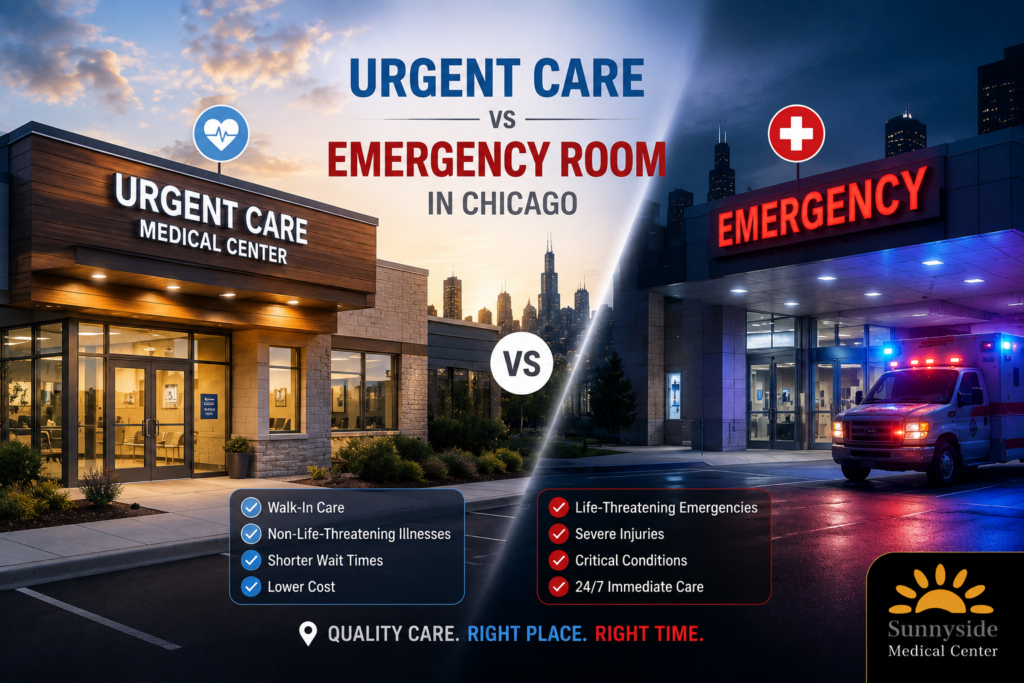
You wake up at midnight with a fever that won’t break. Or your kid falls off a bike and scrapes up an elbow bad enough to worry you. The question hits fast. Do you go to urgent care or do you go to the emergency room. That decision matters. It affects your wait time and your wallet. And sometimes your safety.
A lot of people in Chicago aren’t sure when to go to urgent care versus when to go to the er and that’s a normal thing to wonder about especially with something like a high fever or a sprain that could go either way. Nobody wants to stand around figuring out where to go when they’re sick or injured. Knowing where to go for care before you actually need it makes the moment a lot less stressful and it helps to know when to go and know where to go before the middle of the night decision hits.
This piece breaks down twelve symptoms urgent care can usually treat and six that mean you should go to the emergency room or call 911. It also covers how urgent care is different from your primary care doctor and what a visit at Sunny Side Medical Center in Chicago actually looks like.
None of this replaces a real exam from a real provider. Think of it as a starting point so you aren’t standing in your kitchen at midnight trying to guess whether a symptom can wait until morning or needs medical attention right now.
Urgent Care or the ER: Quick Way to Tell
Here’s the simple rule. Whether you call it choosing between urgent care or the emergency room weighing er or urgent care or wondering if you should go to urgent care instead the same basic idea applies. If a symptom feels life threatening go to the emergency room or call 911. If it’s uncomfortable or worrying but stable urgent care is usually the better option and a faster one.
The difference between urgent care and the emergency room really comes down to how serious the symptom is and how fast it’s getting worse. Some people call it a clinic or urgent care and others call it a walk in clinic or an urgent care center. Different names same basic care facility built to handle what your primary care office can’t fit in today. Emergency rooms are open around the clock for a reason. That’s exactly why they exist for true emergencies at any hour of the night.
| Urgent Care | Emergency Room | |
|---|---|---|
| Best for | Non life threatening illness or injury needing same day care | Life threatening symptoms or a major injury |
| Appointment needed | No walk in accepted | No walk in accepted |
| Examples | Fever sore throat sprains minor cuts | Chest pain trouble breathing heavy bleeding stroke signs |
| Typical wait | Often shorter for non emergency issues | Emergency cases are seen first so a non emergency case can wait longer |
What Is Urgent Care
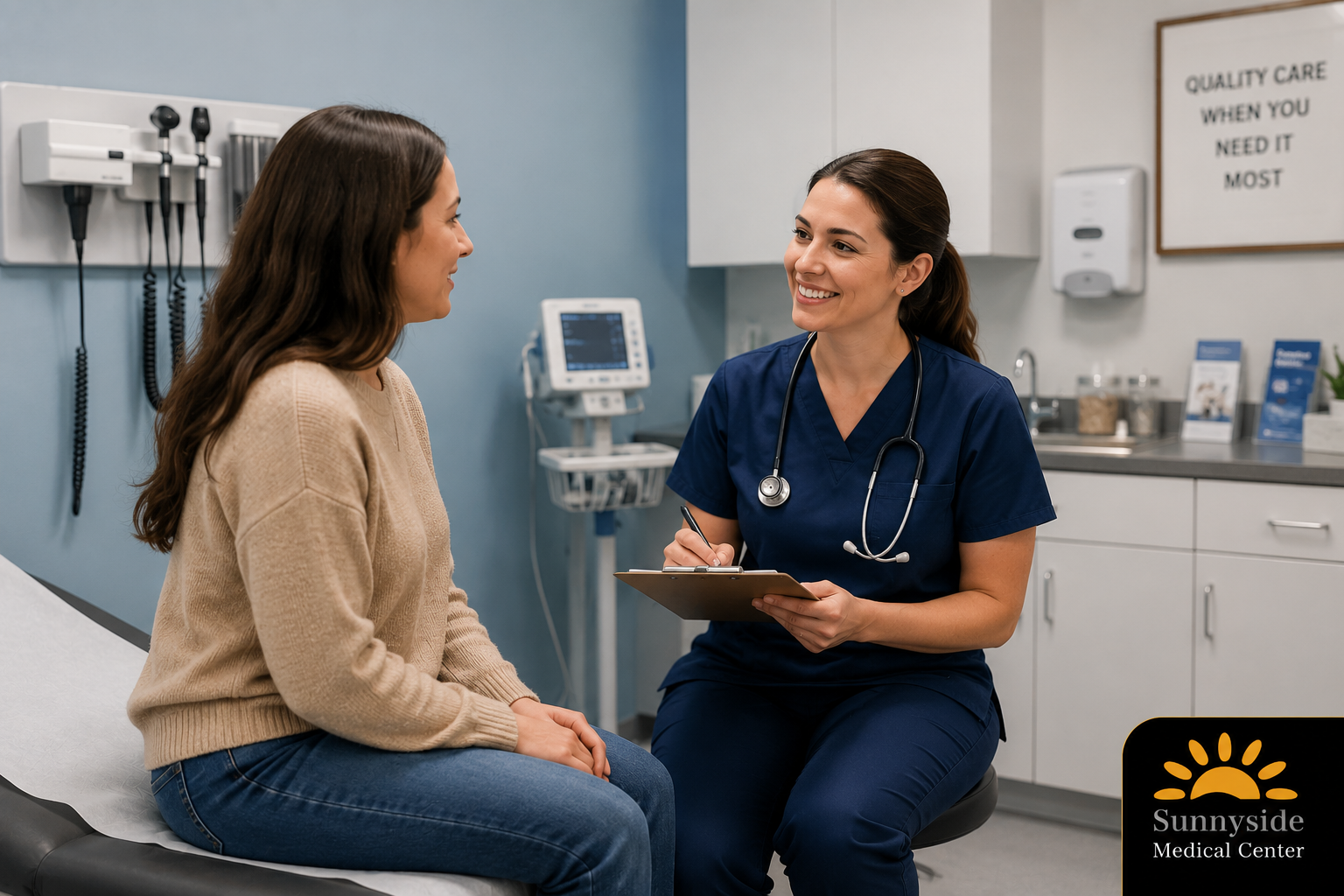
Urgent care is a walk in clinic built for illness or injury that needs same day medical attention but isn’t life threatening. You don’t need an appointment. And you don’t need to already be an established patient there.
An urgent care center is sometimes called an urgent care clinic or an urgent care facility and all three describe the same kind of care facility. Urgent care facilities are typically staffed by health care professionals such as physician assistants and nurse practitioners working alongside physicians to provide medical care fast. That’s different from an emergency medicine physician who works inside a hospital emergency room and handles the most severe cases that come through the door. Some clinics also offer virtual care for simple follow ups though that’s worth confirming directly with whatever clinic you plan to use. Think of urgent care as after hours care and immediate care rolled into one so a health concern that pops up outside your regular office hours still gets handled.
Urgent care at Sunny Side Medical Center serves the Logan Square and Humboldt Park area of Chicago from 3228 W. North Ave. The clinic accepts in network insurance out of network insurance and self pay so a lack of coverage doesn’t have to keep someone from getting seen the same day.
The whole point of urgent care is speed and access. You skip the long wait that comes with an emergency room and you skip the days long wait that can come with a primary care office that’s fully booked. For a lot of Chicago residents that middle option is exactly what a Tuesday night sore throat or a weekend sprain calls for. It isn’t meant to replace either the ER or your regular doctor. It sits between the two and covers the gap. Some people even describe it as urgent care or walk in care interchangeably since they mean the same thing.
12 Everyday Symptoms Urgent Care Can Handle
Urgent care centers treat far more than most people realize. Urgent care services include a wide range of everyday problems and urgent care is often the faster choice for handling them. What urgent care includes ranges from a sore throat to a sprain to a minor burn and the conditions treated at urgent care are typically mild to moderate meaning uncomfortable but not dangerous. Urgent care can provide same day treatment for most minor illnesses and minor injuries.
- Fever. A fever on its own without other severe symptoms including a high fever is something urgent care can check and treat the same day.
- Cough cold and flu symptoms. A runny nose body aches and a cough that won’t quit are common reasons Chicago patients walk into urgent care during cold and flu season. Getting a flu shot each fall through vaccinations is one form of preventive care that can lower your odds of landing here in the first place.
- Sore throat. Strep throat and other causes of a sore throat can be checked with a quick test at urgent care.
- Sinus infection. Facial pressure and thick drainage that lingers past a week is worth a same day visit.
- Ear infection. Ear pain especially in kids is one of the most common urgent care visits.
- Allergy flare ups and mild asthma symptoms. Sneezing itchy eyes and a mild wheeze can be treated at urgent care rather than waiting days for a primary care slot. For ongoing allergy trouble allergy testing can help pin down the exact trigger.
- Minor cuts. A cut that’s bleeding but controlled and may need cleaning or stitches belongs at urgent care and not the ER.
- Minor burns. Small burns from cooking or a curling iron can usually be treated without a trip to the emergency room.
- Sprains. A twisted ankle or wrist that hurts but still moves is a classic urgent care visit.
- Headaches and migraines. A headache that feels like your usual pattern and isn’t the worst headache of your life fits urgent care.
- Stomach discomfort nausea or vomiting. Ongoing stomach discomfort without severe abdominal pain can often be managed at urgent care. Sudden severe abdominal pain that comes on fast and won’t ease up is a different matter and is worth an emergency room look instead.
- Rashes and minor skin infections. A new rash or a small area of skin infection is worth a same day look before it spreads.
Urgent care also handles other everyday health concerns such as urinary discomfort and minor infections. If you need bloodwork or a lab test done the clinical lab can often take care of that on site during the same visit.
6 Symptoms That Mean You Should Go to the Emergency Room
No quiz needed for this one. Six symptoms. That’s it. These are signs of a possible medical emergency and mean it’s time for real emergency care not a wait and see approach. If you or someone near you has one of these get to the emergency room or the nearest hospital emergency department right away or call 911. Don’t drive yourself if you feel faint or unable to drive safely. And don’t waste time typing closest er near me into your phone. Call 911 instead and let dispatch send help or walk you through what to do.
| Symptom | Why it needs the ER |
|---|---|
| Chest pain or pressure | May signal a heart problem |
| Trouble breathing or severe shortness of breath | Oxygen levels can drop fast |
| Heavy bleeding that will not stop | Risk of shock |
| Sudden one sided weakness or trouble speaking | Possible stroke |
| Head injury with loss of consciousness or a deep wound | Risk of serious internal injury |
| Sudden confusion or fainting | Possible serious underlying cause |
- Chest pain or pressure. Chest pain or pressure lasting more than a couple of minutes can point to a heart problem and needs emergency evaluation according to the American College of Emergency Physicians.
- Trouble breathing or severe shortness of breath. Struggling to breathe or catch your breath is always an emergency room visit and not something to wait out.
- Heavy or uncontrolled bleeding. Bleeding that won’t stop with direct pressure needs emergency care right away.
- Sudden one sided weakness numbness or trouble speaking. MedlinePlus lists sudden one sided weakness and a sudden inability to speak or walk as reasons to call 911 since these can be signs of a stroke.
- A serious injury such as a bad head injury loss of consciousness or a deep wound. MedlinePlus specifically names head injuries with loss of consciousness as an emergency that belongs at a hospital emergency room.
- Sudden confusion fainting or a major change in mental state. The American College of Emergency Physicians lists confusion and sudden dizziness or fainting among the warning signs that shouldn’t wait.
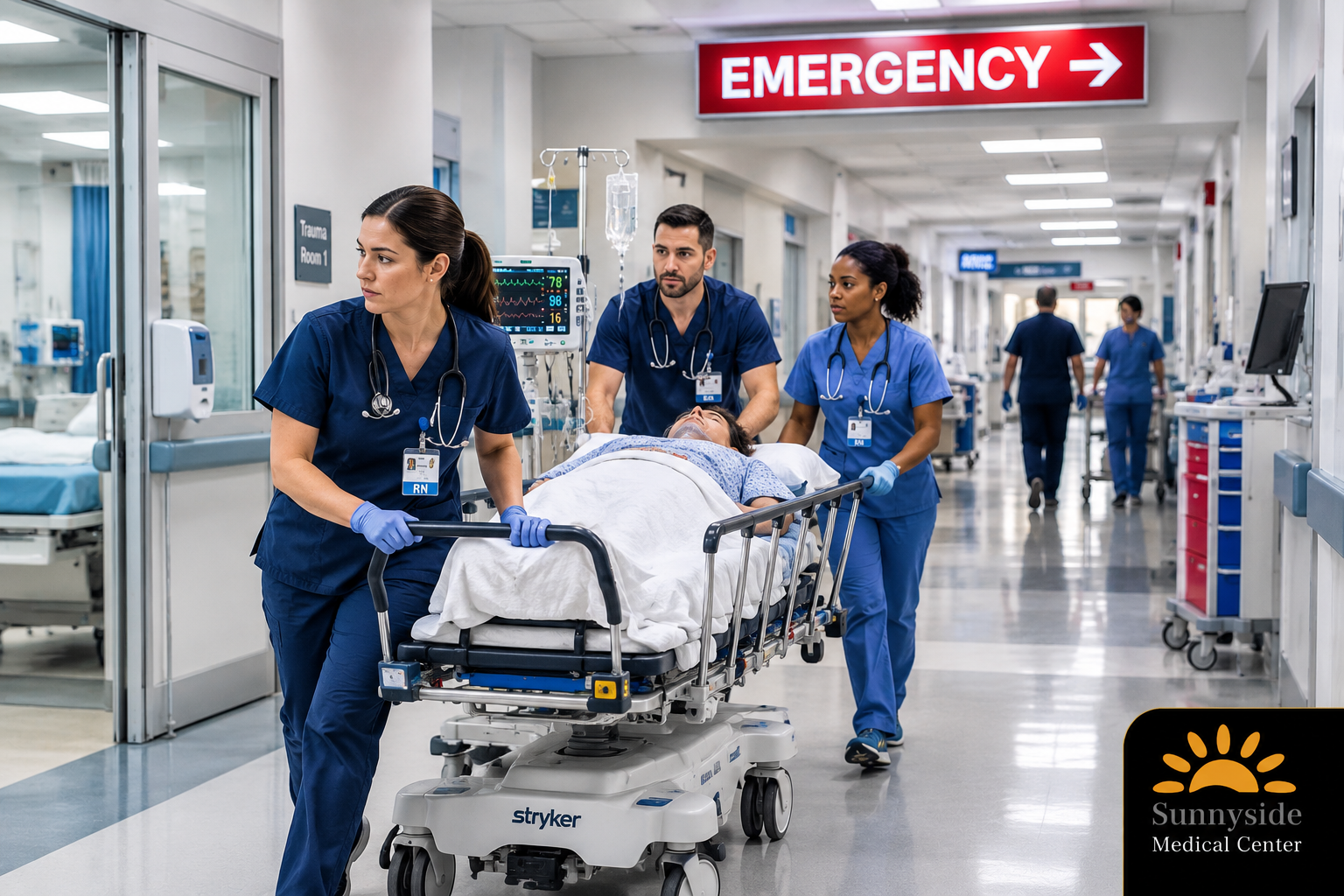
If any of these symptoms show up go to an emergency room right away or call 911. Sunny Side Medical Center is an urgent care and primary care clinic and it isn’t equipped to handle medical emergencies like these. When a higher level of care is needed a hospital emergency room is simply the right care location for the level of care involved. If it’s truly severe don’t try urgent care. Choose the emergency room instead.
Urgent Care vs Primary Care in Chicago
Urgent care is for a sudden problem that needs same day attention. Your primary care physician also known as your primary care doctor or primary care provider handles ongoing health needs checkups and conditions that aren’t a same day emergency.
If your primary care doctor is unavailable or your regular doctor office is already closed for the day urgent care can fill the gap for a new problem that can’t wait until the next available appointment. Chronic disease management and other ongoing health management still belong with your primary care provider so the two work best together rather than as a replacement for each other. Preventive care such as checkups screenings and vaccinations is also best handled by seeing your primary care provider on a regular schedule rather than through an urgent care visit.
Here’s a simple way to think about it. Your primary care provider knows your health history and manages things over time such as blood pressure diabetes or a medication refill. Urgent care doesn’t have that history in front of them so it works best for a stand alone problem that showed up today and needs to be looked at now. Neither one is the better option across the board. It depends on what you actually need that day and whether the care is needed right now or can wait for your next checkup.
What to Expect at Sunny Side Medical Center Urgent Care
You don’t need to call ahead. No appointment. Just walk in during business hours and you’ll be seen the same day. Bring a photo ID and your insurance card if you have one though self pay patients are also welcome.
Sunny Side Medical Center is located at 3228 W. North Ave. in the Logan Square and Humboldt Park area of Chicago. James Vacracos PA C is part of the provider team and you can read more about the clinic on the about us page.
The clinic is open Monday through Friday from 9am to 5pm and Saturday from 9am to 1pm. It’s closed on Sunday so plan around those hours if something comes up over the weekend or go to the emergency room if it can’t wait.
Questions Worth Asking During an Urgent Care Visit
A little preparation makes any medical visit go smoother. Before or during your visit it helps to have a short list ready.
That includes how long the symptom has been going on and whether it’s gotten better or worse. It also helps to know any medications you already take and any allergies you have since that changes what a provider can safely recommend. And if you’re there for a child it helps to know their weight and their last vaccination if you have that information handy.
Don’t be shy about asking what to watch for after you leave either. A good visit ends with you knowing what a normal recovery looks like and what would mean coming back or going to the emergency room instead.
Insurance and Paying for Urgent Care in Chicago
Sunny Side Medical Center accepts in network insurance out of network insurance and self pay so cost shouldn’t be the reason you skip a visit you need. If you have questions about your specific plan the contact us page is the fastest way to reach the clinic before your visit.
A quick call ahead can also save you a surprise at checkout. Insurance plans differ on copays and out of network coverage so if cost is a concern it’s worth asking about your specific situation before you walk in rather than after. Self pay patients are welcome and staff can walk you through what a visit involves before you commit to anything.
Frequently Asked Questions About When to Go to Urgent Care
What is urgent care used for?
Urgent care is for an illness or injury that needs medical attention the same day but isn’t life threatening. Think fever sore throat sprains minor cuts and similar issues that can’t wait for a regular doctor appointment but don’t require an ambulance.
Should I go to urgent care or the emergency room?
If the symptom feels life threatening such as chest pain trouble breathing or heavy bleeding go to the emergency room or call 911. If you’re asking yourself should I go to the hospital for something like that the answer is yes go now. For everything else that needs same day care but is stable urgent care is usually the faster and lower cost option.
Is urgent care cheaper than the emergency room?
For a non emergency issue urgent care is generally a lower cost option than an emergency room visit for the same problem though the exact cost depends on your insurance plan and the visit itself. Emergency rooms are built and staffed for the most severe cases so a routine issue handled there tends to cost more than the same issue handled at a walk in clinic.
Does urgent care treat adults and children?
Urgent care for adults and urgent care for kids covers a lot of overlap though scope can vary by clinic. Call Sunny Side Medical Center at 773 292 9660 ahead of your visit if you want to confirm the visit fits your situation.
Do I need an appointment for urgent care?
No. Urgent care is built for walk in visits. You can arrive during business hours without scheduling ahead and be seen the same day.
What should I bring to an urgent care visit?
Bring a photo ID and your insurance card if you have one. If you’re a self pay patient you can still be seen since Sunny Side Medical Center accepts in network out of network and self pay patients.
Should I see my primary care doctor or go to urgent care?
If your concern is ongoing such as a chronic condition or a routine checkup see your primary care provider for that ongoing management instead. If it’s a new problem that needs attention today and your primary care doctor is unavailable urgent care can fill that gap.
Is urgent care open on weekends?
Sunny Side Medical Center is open Saturday from 9am to 1pm and closed on Sunday. Weekday hours run Monday through Friday from 9am to 5pm.
What is the difference between urgent care and a walk in clinic or emergency clinic?
Urgent care walk in clinic and emergency clinic are terms often used for the same type of same day non emergency care though naming can vary between businesses. Emergent care is another term some businesses use and it usually just means urgent care too. An emergency room or emergency department is a different and higher level of care meant for life threatening situations.
What happens if my condition turns out to be more serious than I thought?
If the provider examines you and finds your condition needs a higher level of care than urgent care can provide they will direct you to the emergency room. Being seen first at urgent care doesn’t delay care for something serious. It simply helps sort out where you need to be and whether you receive medical care on site or get sent on for a higher level of care.
A Quick Disclaimer
This content is for general information only and it doesn’t replace advice diagnosis or treatment from a licensed medical professional. If you think you’re having a medical emergency call 911 or go to the nearest emergency room right away.
Getting the Right Care When You Need It
Knowing when to go to urgent care and when to go to the emergency room comes down to one question. Is this life threatening or not. That’s really it. Urgent care at Sunny Side Medical Center can handle the twelve everyday symptoms above the same day with no appointment needed and it accepts in network out of network and self pay patients. The six symptoms under the emergency room section aren’t something to wait out so call 911 or go to the nearest emergency room if you see them.
If you’re dealing with something on the urgent care list today walk in during business hours or book an appointment ahead of time.
- Email: info@sunnysidemedicalcenter.com
- Address: 3228 W. North Ave. Chicago IL 60647
- Phone: 773 292 9660
Stay connected with Sunny Side Medical Center. Follow us on LinkedIn, Instagram and Facebook for health tips clinic updates and more.

